Richard Pringle (Member no: 1931)
Mitchell's Fold
Peaceful in the sunlight and wild when the wind roars
Some time ago the Stone Club sent me a copy of Stone Circles - A Field Guide, by Colin Richards and Vikki Cummings. To win it, I told them the name of my favourite stone circle. It was a generous prize and so it seems only fair that I take moment now to share more about Mitchell's Fold, and why it is so important, in return.
I live in Shropshire, in the Midlands of England and on the border with Wales. Shropshire is not rich in stone circles. Castles, yes. Geology? For sure. We also boast a decent complement of barrows, and our hill forts are second to none. But we only have two surviving stone circles, which are maybe 3 miles apart, and very close to the Welsh border. However it's quality, not quantity, that counts, and Mitchell's Fold is breathtaking.
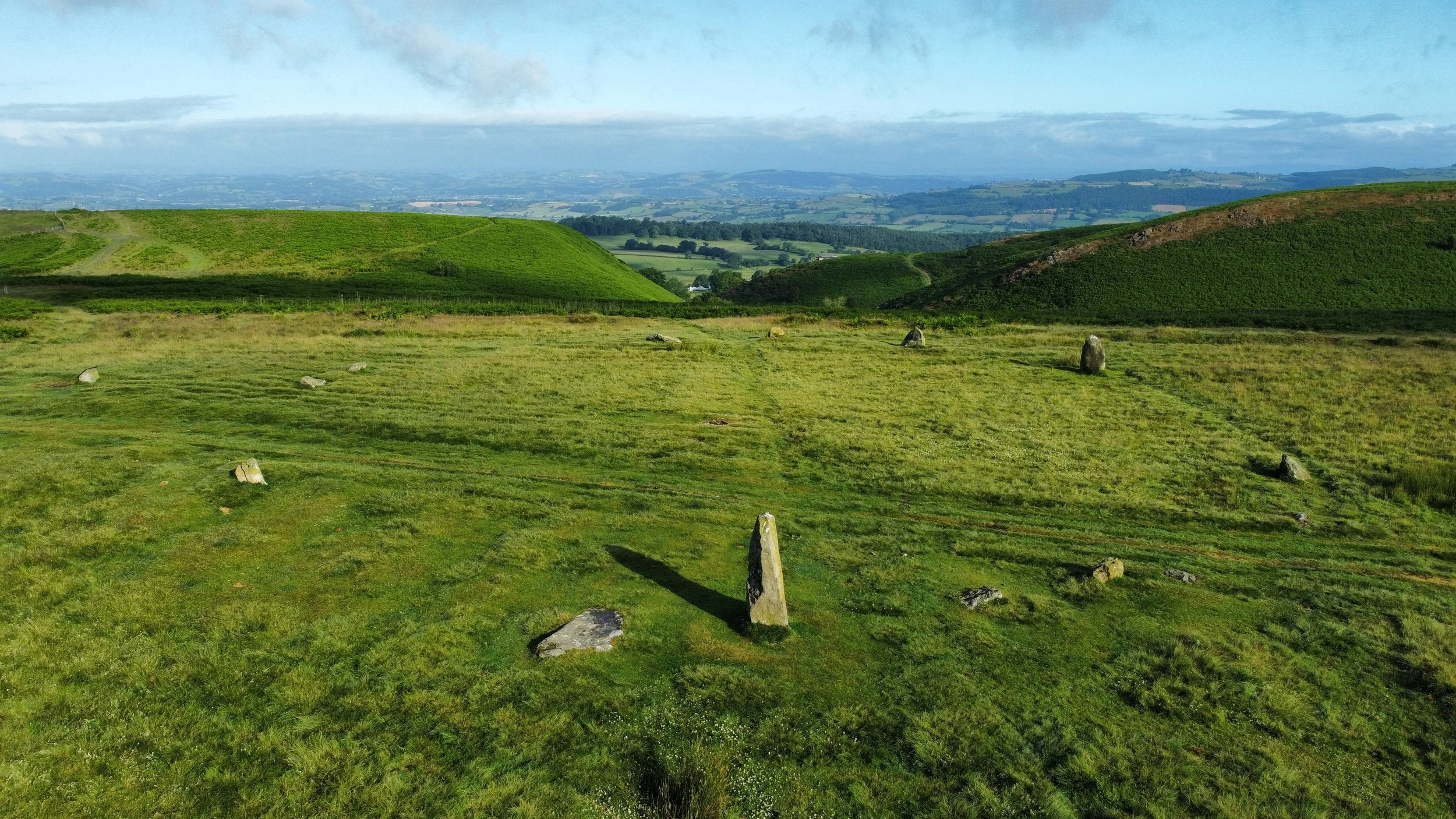
Approaching from the car park, you cross a cattle grid and begin to ascend a gentle slope. You might find yourself wondering if you've missed them altogether, when they suddenly appear in front of you: 15 stones of varying heights (but there may have once been up to 30) arranged in a rough circle on a windswept hillside. To the south and west, the land seems to fold away and the views are magnificent as green fields turn to blue hills. Even the turf is lovely to walk across, soft and spongey. The wind is often overpowering as it rushes up the slope. It feels isolated and when the wind drops, the stillness is palpable.
The wider landscape is rich in prehistory. Nearby sit the Hoarstones, which are almost an inverse of Mitchell's Fold -- low lying and shadowed by surrounding hills. A third circle nearby, the Whetstones, was destroyed by Victorian quarrying. There were probably more. Around Mitchell's Fold itself are two standing stones, several burial cairns and a long barrow, while three miles away pictrite axes were crafted at the Cwm Mawr quarry. Corndon Hill crouches behind, crowned with barrows. Walking around Mitchell's Fold connects you irresistibly to the world of your forefathers (and mothers). This was a busy place.
Like all good ancient sites, Mitchell's Fold has some folklore behind it. The most well known legend tells that a kind giant (or sometimes a fairy) took pity on the starving during a famine, and gifted a magic cow that produced endless milk. A witch took advantage of this generosity by milking the cow into a sieve until it was drained dry. The cow disappeared while the witch was turned to stone with a circle erected around her to trap her there forever.
Maybe the witch simply had lots of mouths to feed. Whether there was once a central stone (perhaps an earlier standing stone, later encircled) has not yet been conclusively decided, so perhaps the witch was able to escape.
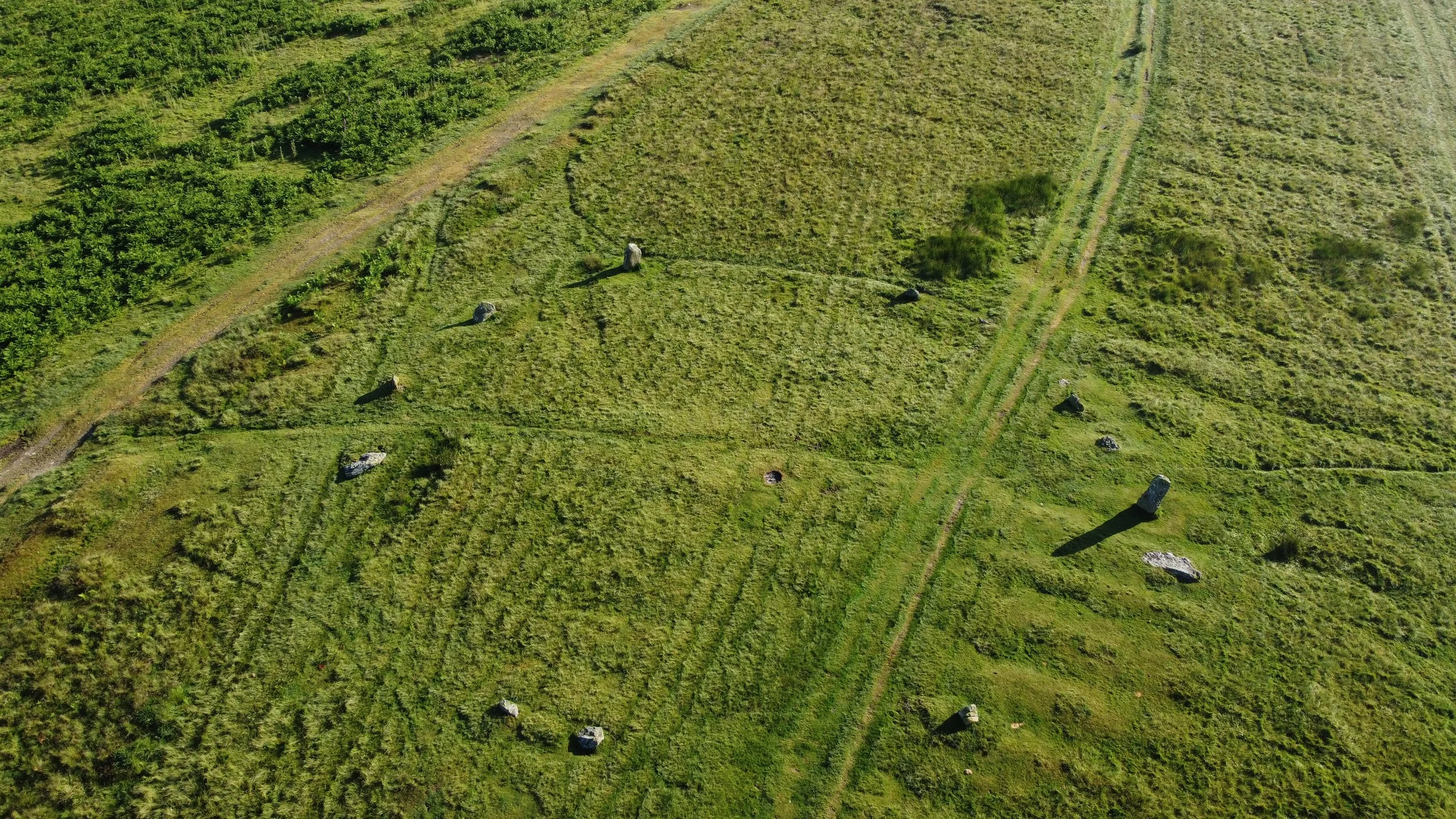
What fascinates me most about this site are the traces of medieval ridge and furrow that seem, from the air, to encroach very slightly into the ring. Do they mean that the circle is younger than it appears? A post-medieval folly, despite being in such a rich bronze age andscape? Have the stones been moved at some point? Perhaps the stones were a useful field marker, and didn't get in the way, but I have this fanciful idea that some of the stones had already been dislodged when our medieval ancestors farmed the site for crops, and were replaced, with reverence, when ploughing ceased.
Mitchell's Fold is a wonderful place: peaceful in the sunlight and wild when the wind roars. It's a place where pre-history, history, archaeology and folklore mingle easily like old friends and has inspired artists, antiquarians and archaeologists for generations: pioneering archaeologist Lily F. Chitty made a wonderful painting of the stones in 1924.* It is easy to imagine Lal Chitty hunched over her watercolours, or medieval farmers reclining against the stones during a break from the plough. It has been a special place to many -- including, on a personal note, to me and my wife, who agreed to marry each other over a Solstice sunset picnic here.**
* I have a print, but I don't know how copyright works.
** As in, the agreement to marry was made here. The wedding itself was at Lochbuie Standing Stones on the Isle of Mull, but that's a different story.