Ian Simmons (Member no: 2866)
Kit’s Coty House
I found myself here at Kit’s Coty House, mildly cursing the sturdy tweed jacket I’d chosen assuming chillier weather
Kit’s Coty House – 30 September 2025
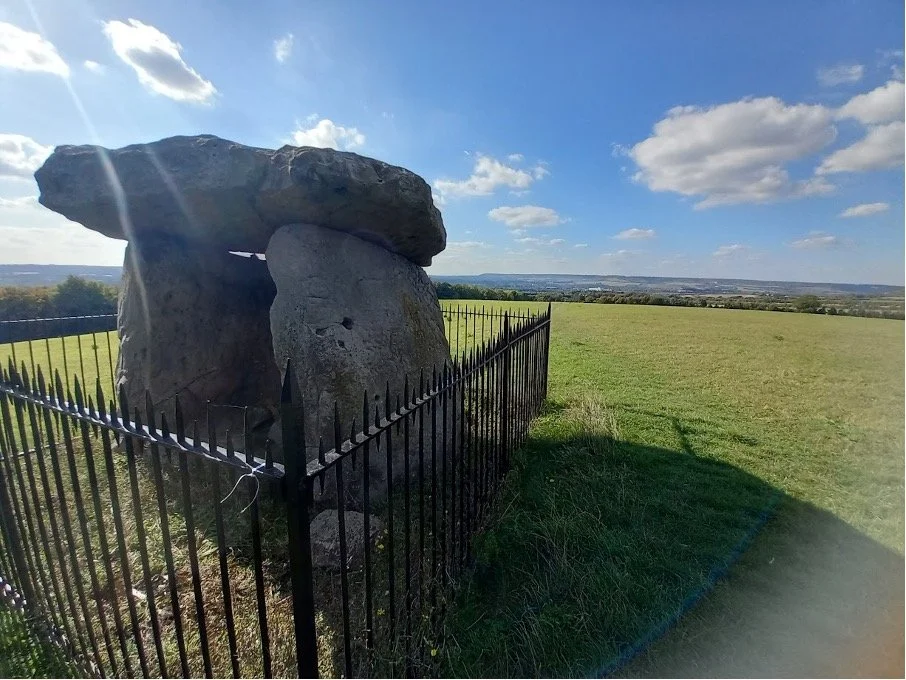
Kit’s Coty House is a neolithic dolmen, located where, by all logic, no ancient stones should be – near the village of Aylesford in Kent, just east of where London’s suburban sprawl finally runs out of steam, and south of the Thames-side straggle of the Medway towns. But none the less, here it is, just a few yards from Bluebell Hill, sitting in a field atop a hill, overlooking an improbably lovely and bucolic stretch of English countryside, one of Britain’s earliest megalithic monuments. For all its proximity to London and its suburbs, Kit’s Coty House is not well known – I was brought up not many miles away in south London, yet was never really conscious of it. My father’s family came from Sevenoaks, which is no distance at all from the stones, but he never mentioned it, and it really isn’t on the tourist map, despite writers from as far back as Samuel Pepys recording their visits to the monument; Dickens, dwelling in nearby Chatham, came, and George Orwell too, among others.
For all that though, Kit’s Coty House was probably the first neolithic monument I encountered outside Stonehenge. Growing up in England, Stonehenge is just there, it is part of the cultural backcloth of the nation, and I suspect, there are many people who still don’t realise there are other stones - I am not sure I did as a child. But in, I think, late 1969, when I would have been eight, about to turn nine, and in the third year of Gilbert Scott Junior school in Addington (the Surrey one, not the Kent one near the stones) I was in Miss Roberts class. Now, this was the year I found books; the class library contained all the Famous Five books, which I inhaled with great enthusiasm, but it was the books Miss Roberts read to us in instalments just before home time that had the profound effect; Finn Family Moomintroll, Elidor, Eagle of the Ninth, The Hobbit…. and Stig of the Dump. In Stig of the Dump, a boy, Barney, has befriended Stig, a relict “caveman” living in a local quarry used as a tip, and at one point he visits some ancient stones. Peter Ross, in Upon a White Horse says these must be Kit’s Coty House, both from their location – Stig takes place in Kent - and their description, so this was probably the first neolithic monument outside of Stonehenge that I became aware of, not that I knew it at the time as it is never named in the book. The books I had read to me in that Addington classroom shaped me profoundly and for that I owe Miss Roberts a vast debt of gratitude; to this day I still love Alan Garner and Tove Jansson, and Stig, I think, piqued my curiosity about the ancient past that led me to an interest in stones.
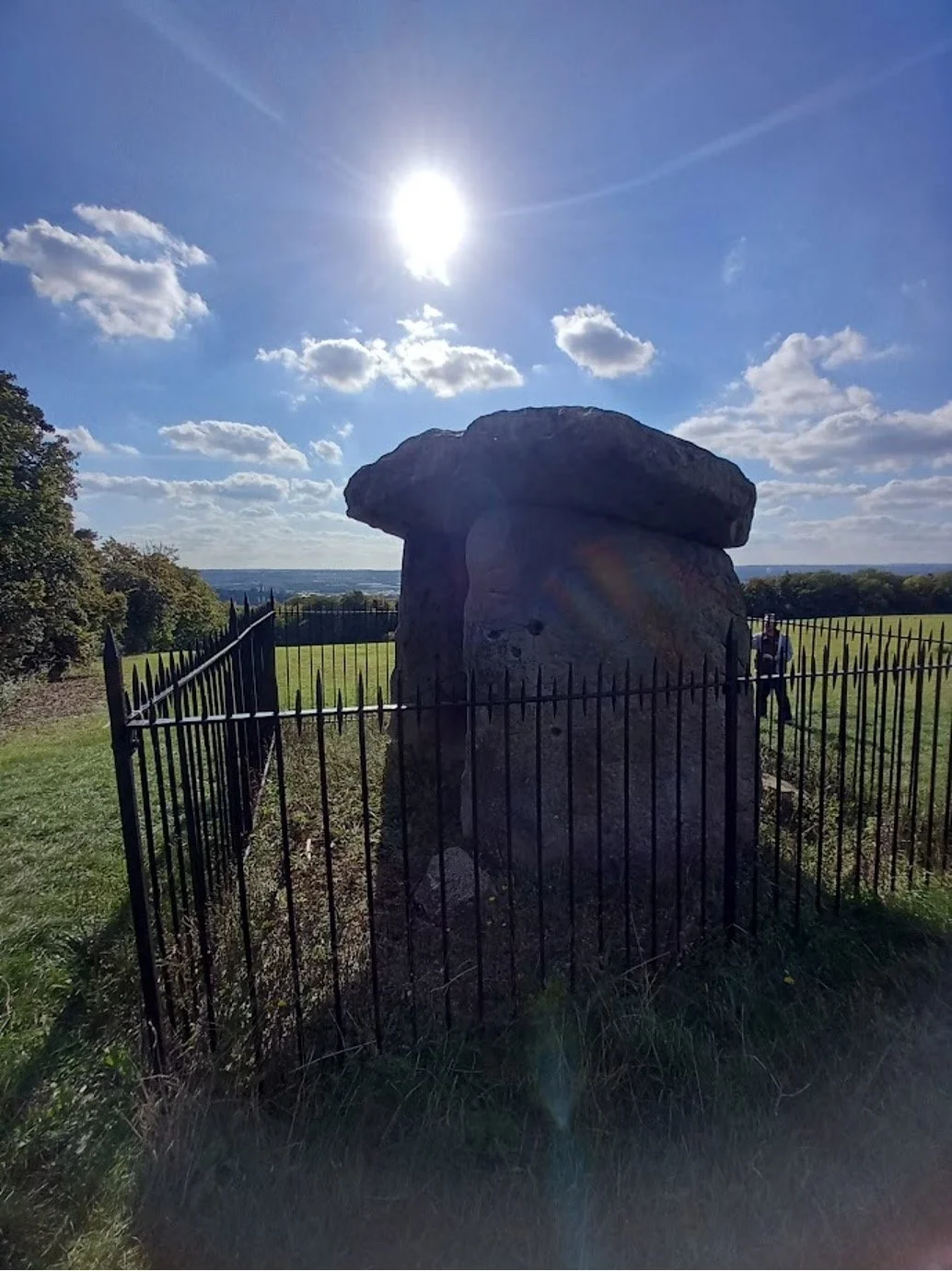
So it was then, that on a lovely day in the Indian summer of late September, I found myself here at Kit’s Coty House, mildly cursing the sturdy tweed jacket I’d chosen assuming chillier weather, recording an episode of the Uncanny podcast with Danny Robins about road ghosts, in which we speculate that the ancient energies that prompted the construction of Kit’s Coty House might also have something to do with ghosts on nearby Bluebell Hill. While signposted, the monument is not exactly easy to find. We got to it down some half-concealed steps off the old Bluebell Hill road (superseded by a dual carriageway in the 70s and now a quiet country road), which led us to a steep, tree shaded, downhill track that could conceivable have been there when Kit’s Coty House was built. A little way down, and off to our right, we stepped through a gap in the hedge and into the large grassy field where the stones stand almost immediately in front of you. Danny, who had not been there before, was amazed to see the megalith here in all its glory; you could be feet away on the track and never realise it was there.
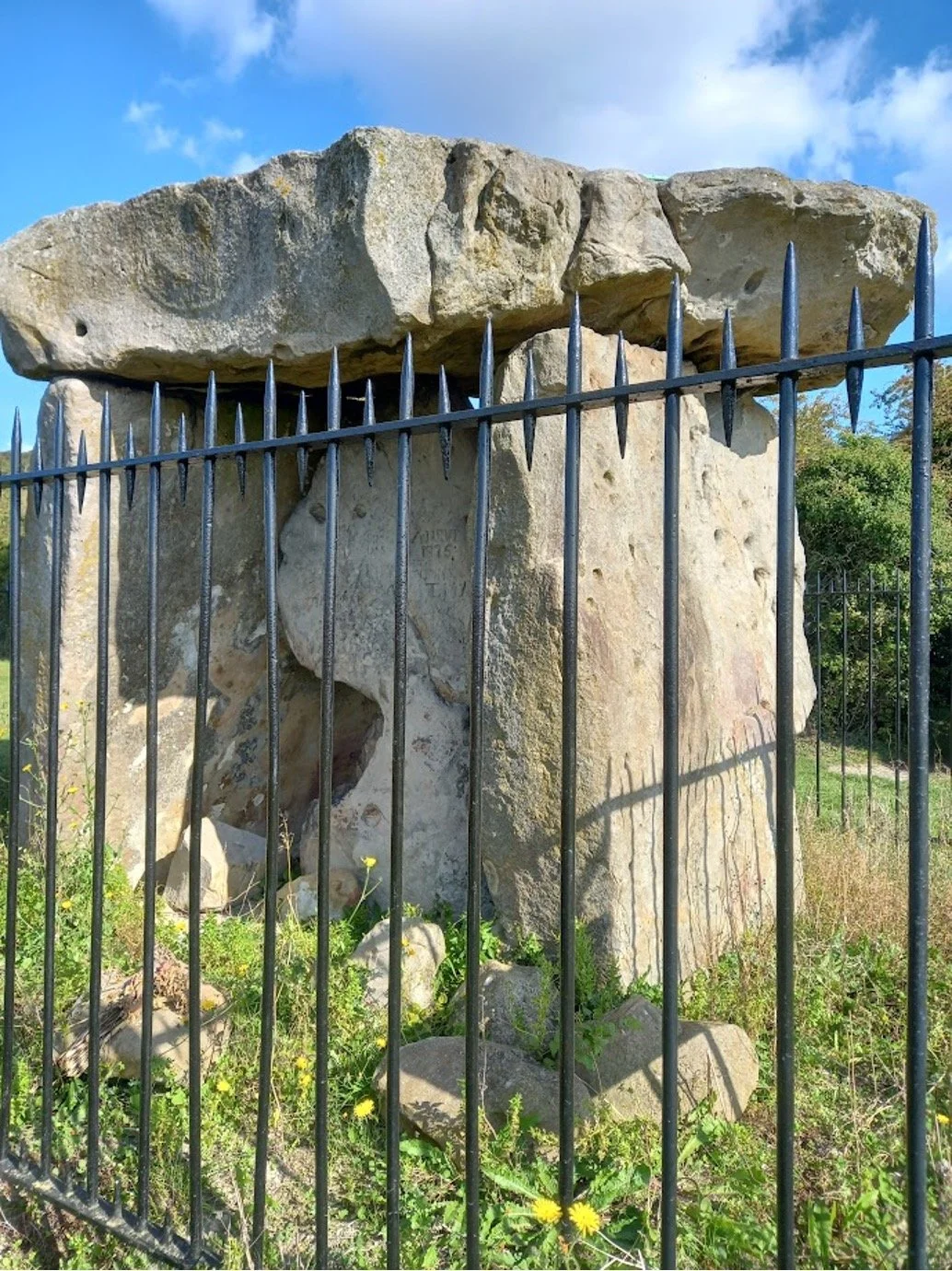
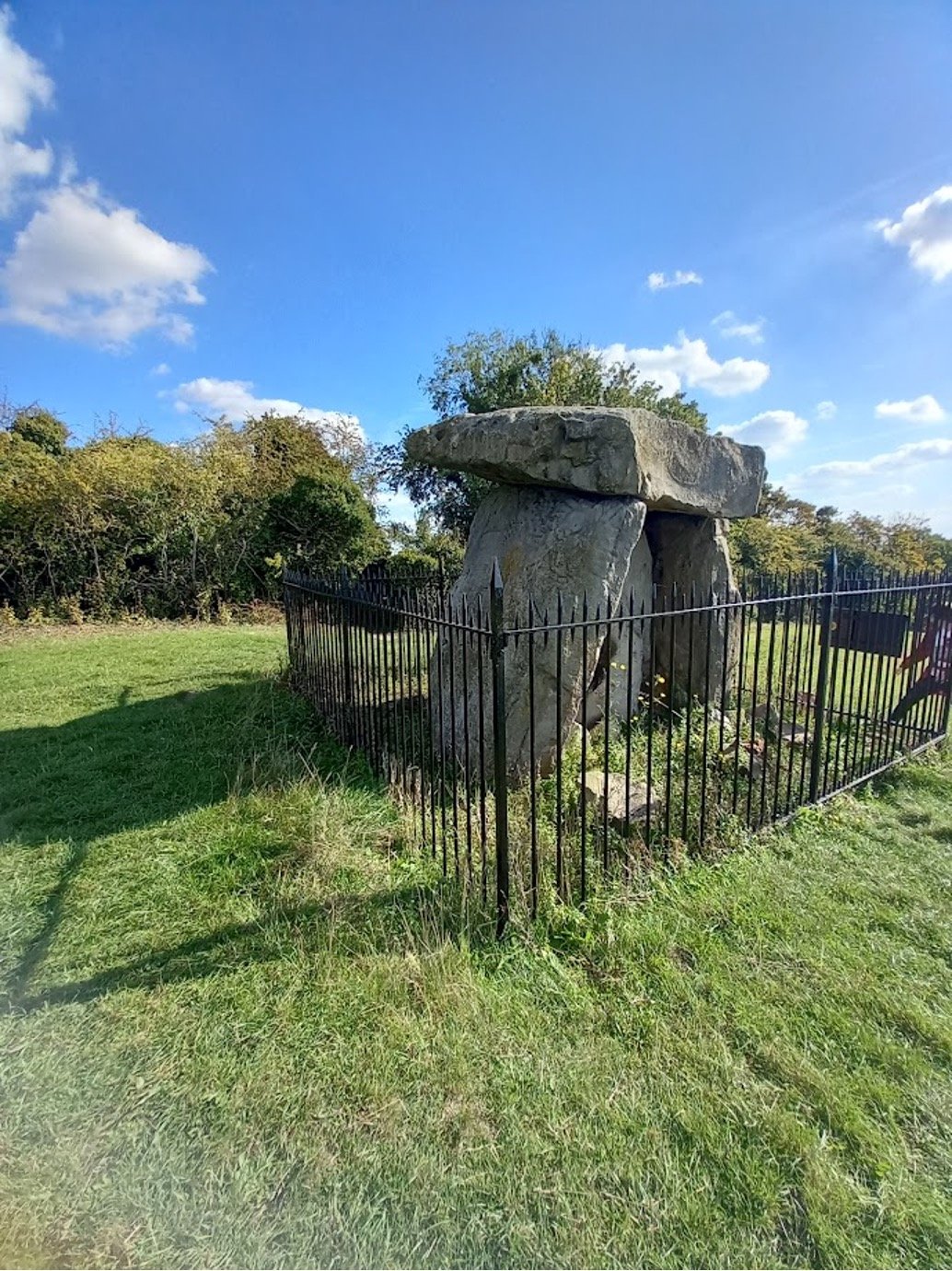
The structure is a classic dolmen, built out of three upright orthostats with a capstone, all made of sarsen, and would have been part of a now vanished barrow structure thought to have been about 70 metres long, one metre high, and between 11 and 15 metres wide. The stones, which once formed the entrance to the barrow, are now somewhat incongruously imprisoned within an iron fence of forbidding spikiness. This, though, is historic in its own right. Kit’s Coty House was one of the first megaliths taken under state protection in the late 19th century, by General Augustus Pitt-Rivers, the first Inspector of Ancient Monuments, and it is he who had this imposing containment installed. While it might seem insensitive and unnecessary today, evidence on the site suggests it was not in Pitt-Rivers’ day. Then, while attitudes to ancient stones had moved on from seeing them as a source of convenient building materials to one of antiquarian and tourist interest, there was still some way to go before the concept of reverence and preservation took hold. As a result, the central stone is a riot of deeply incised 19th century graffiti, so Pitt-Rivers’ mighty fence was probably a sensible idea, preventing more destruction by enthusiastic visitors, and is now an integral part of the history of the site.
Kit’s Coty House is not alone either; Kent has an entire megalithic landscape, known as the Medway Megaliths. There are several more nearby, including Little Kit's Coty House and the Coffin Stone, while a few miles west, across the Medway can be found the Addington, Chestnuts and Coldrum Long Barrows. I have always found Little Kit's Coty House almost impossible to access; there’s no convenient parking nearby, and there’s not even a verge on the road beside it, so, given its extremely ruined state, I have not felt a massive compulsion to risk life and limb to reach it. Coldrum, though, is a different prospect; it sits in a particularly lovely part of Kent, in a wood overlooked by the North Downs. It has a very convenient English Heritage car park a short distance away and is definitely worth a visit, although I did not make it there this time.
I am planning to move out of the South East again soon, and I am not as young as I once was; my days of being able to scramble about the countryside and hunt inaccessible monuments are clearly numbered, but I would like to return here again, and to the other Medway Megaliths, before I miss the chance, and circle back to that early literary encounter that would foreshadow much that was to come.